
Sampling a Noninteger Number of Cycles
Usually, an unknown signal you are measuring is a stationary signal. A stationary signal is present before, during, and after data acquisition. When measuring a stationary signal, you cannot guarantee that you are sampling an integer number of cycles. If the time record contains a noninteger number of cycles, spectral leakage occurs because the noninteger cycle frequency component of the signal does not correspond exactly to one of the spectrum frequency lines. Spectral leakage distorts the measurement in such a way that energy from a given frequency component appears to spread over adjacent frequency lines or bins, resulting in a smeared spectrum. You can use smoothing windows to minimize the effects of performing a fast Fourier transform (FFT) over a noninteger number of cycles.
Because of the assumption of periodicity of the waveform, artificial discontinuities between successive periods occur when you sample a noninteger number of cycles. The artificial discontinuities appear as very high frequencies in the spectrum of the signal—frequencies that are not present in the original signal. The high frequencies of the discontinuities can be much higher than the Nyquist frequency and alias somewhere between 0 and fs/2. Therefore, spectral leakage occurs. The spectrum you obtain by using the discrete Fourier transform (DFT) or FFT is a smeared version of the spectrum and is not the actual spectrum of the original signal.
The following figure shows a sine wave sampled at a noninteger number of cycles and the Fourier transform of the sine wave.
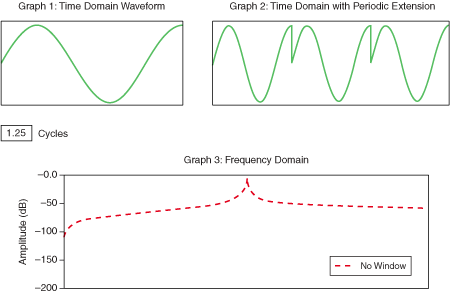
In the previous figure, Graph 1 consists of 1.25 cycles of the sine wave. In Graph 2, the waveform repeats periodically to fulfill the assumption of periodicity for the Fourier transform. Graph 3 shows the spectral representation of the waveform. The energy is spread, or smeared, over a wide range of frequencies. The energy has leaked out of one of the FFT lines and smeared itself into all the other lines, causing spectral leakage.
Spectral leakage occurs because of the finite time record of the input signal. To overcome spectral leakage, you can take an infinite time record, from -infinity to +infinity. With an infinite time record, the FFT calculates one single line at the correct frequency. However, waiting for infinite time is not possible in practice. To overcome the limitations of a finite time record, windowing is used to reduce the spectral leakage.
In addition to causing amplitude accuracy errors, spectral leakage can obscure adjacent frequency peaks. The following figure shows the spectrum for two close frequency components when no smoothing window is used and when a Hanning window is used.

In the previous figure, the second peak stands out more prominently in the windowed signal than it does in the signal with no smoothing window applied.